+91 96500 24436 Call Now

Pandit ji for Arya Samaj Marriage in New Friends Colony

Premium Arya Samaj Mandir Rituals and Shastriya Vidhi for NFC Couples

Talk To Panditji

What is the arya samaj marriage? Understanding the essence of a Vedic wedding.

Decoding 'Vi-vah' and the Sacred Chariot of Grahastashram for a Harmonious Life

The Etymology of Vi-vah: The term Vi-vah originates from 'Vi' (indicative) and 'vah' (vehicle), symbolizing marriage as a sacred vessel designed for two souls through the complexities of life. This is not a mere social contract but a profound spiritual partnership where absolute equality and mutual well-being are fundamental pillars. Without these essential requirements, the bond cannot achieve the "unbreakable" status required to weather life's challenges while remaining spiritually significant.

The Symbolism of the Shakat (Chariot): Vedic Shastras masterfully visualize the union as a Shakat (chariot), where the husband and wife function as two perfectly synchronized wheels. For the "life-chariot" to advance toward its destination without faltering, there must be a rigorous balance of Samya (equality), Sangati (harmony), and Sadgati (virtuous direction). This ensures that both partners operate in total unison, directing their combined energy toward a shared divine purpose and worldly success.

The Union of Three Realms: At its deepest level, Vivah represents the ultimate surrender where two individuals offer their Atma (soul), Hriday (heart), and Sharir (body) to one another. This holistic convergence creates a singular, intertwined entity that transcends the limitations of a standard legal or emotional agreement. By merging these three realms, the couple ensures that their physical, emotional, and spiritual energies are permanently aligned, fostering an eternal connection.

Moral Duty of Grahastashram: The true essence of Vivah lies in the phrase "Vishesh Roop Se Vahan Karna," which signifies the special undertaking of heavy moral and social responsibilities. It is a dedicated Kriya (sacred action) that demands conscious Prayatna (sustained effort) to successfully enter the Grahastashram. In this stage of life, the couple serves as the bedrock of society, upholding the values of discipline, sacrifice, and community service.
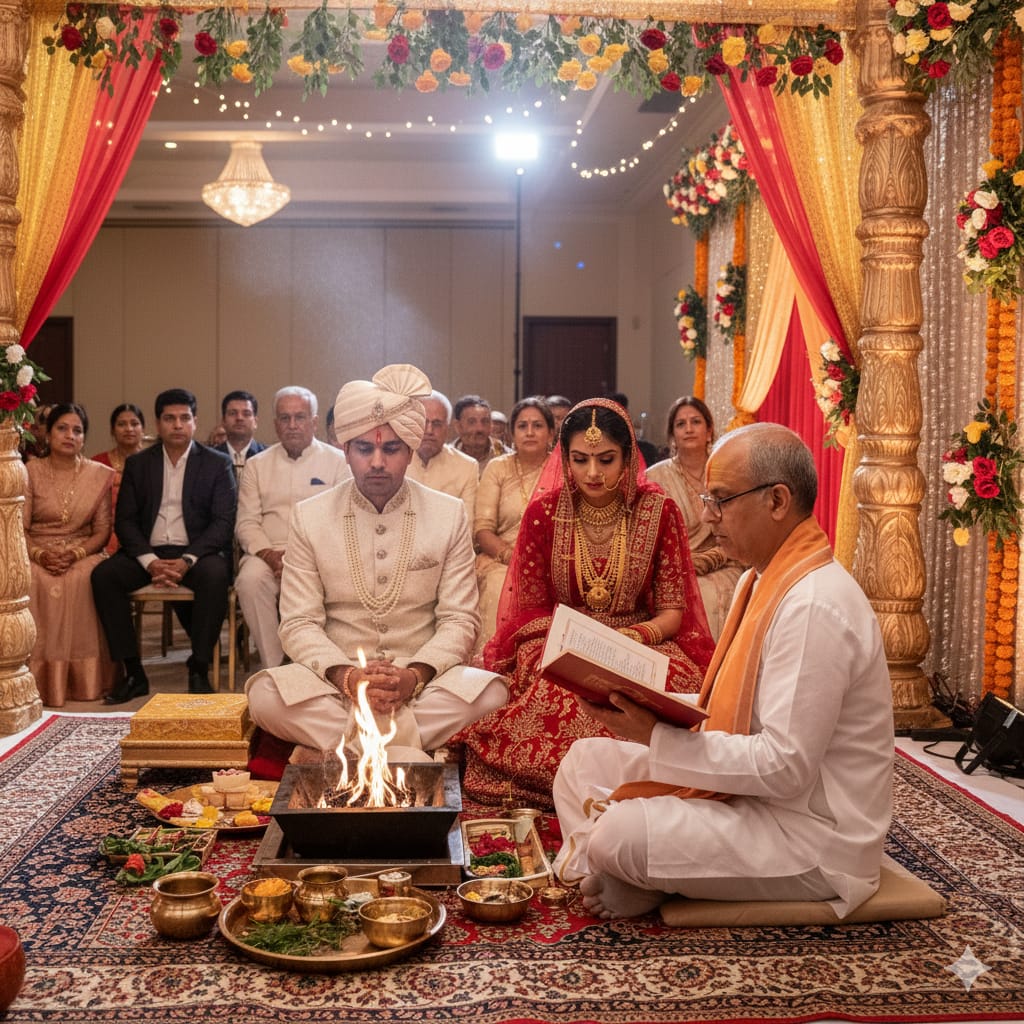
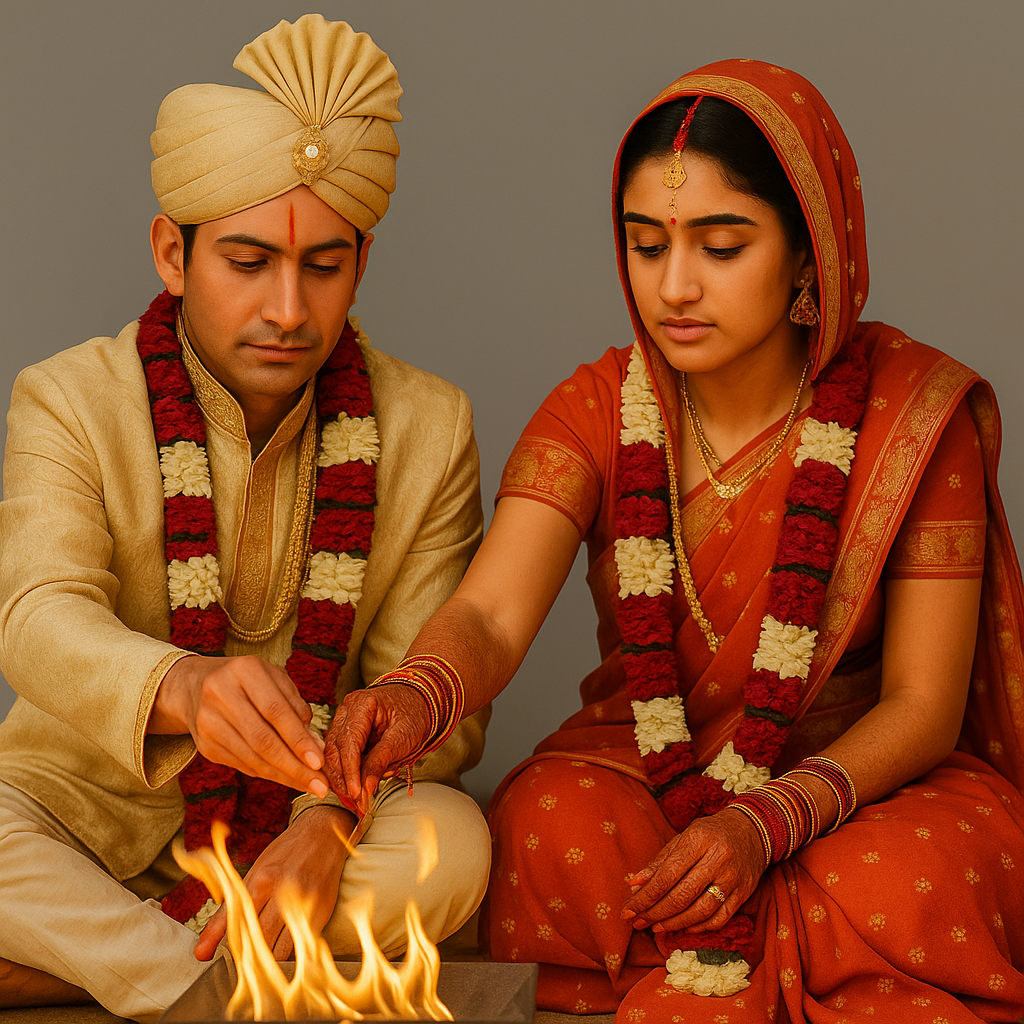
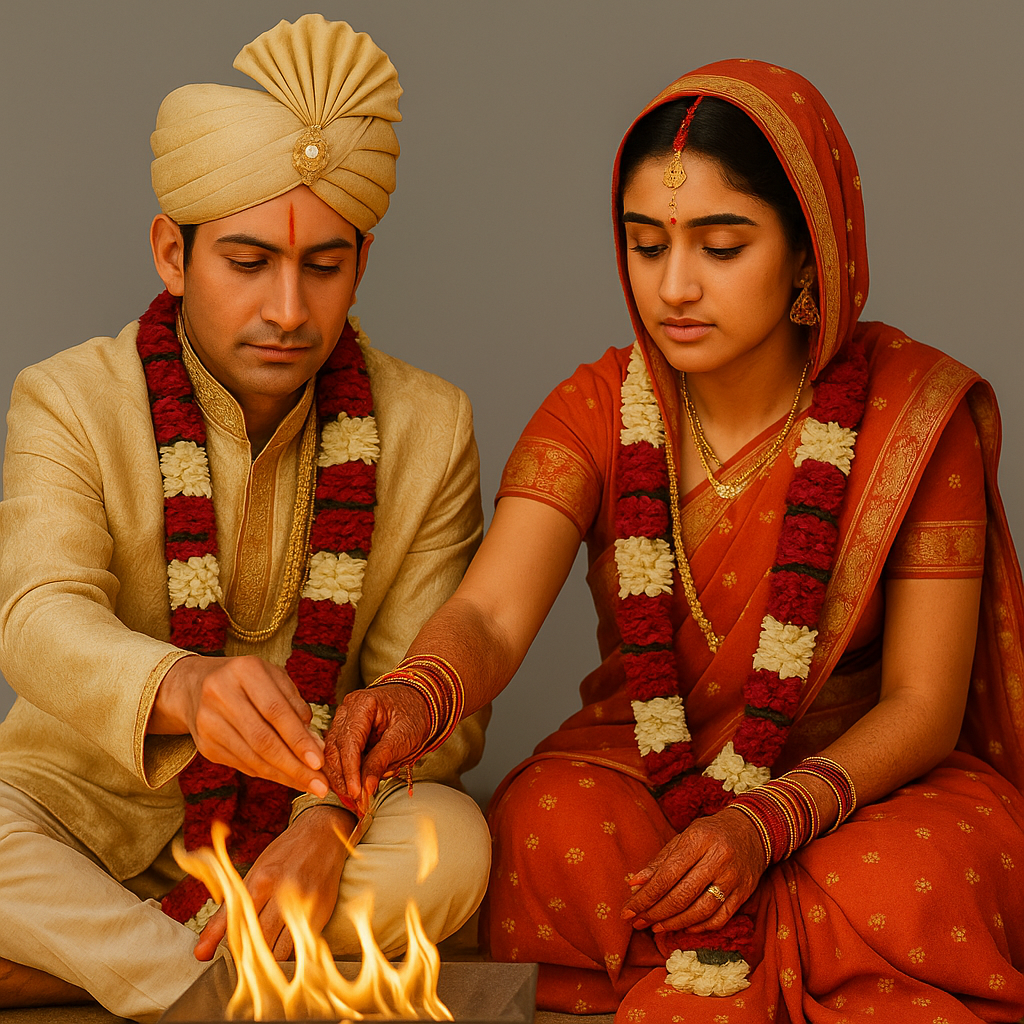
Couple taking Saptapadi vows in an authentic Arya Samaj Marriage in South East Delhi NFC

Vedic Selection in New Friends Colony: Matching Guna, Karma, and Swabhav

Why NFC Couples Choose Character and Lineage: Insights from Darwin and Dr. Magnus Hirschfeld

Vedic Alignment (Guna, Karma, Swabhav): Ancient Vedic wisdom dictates that a sustainable marriage is built on the synchronization of Guna (inherent attributes), Karma (actions and lifestyle), and Swabhav (inner nature). When these three dimensions align, it creates a psychological and spiritual synergy that ensures long-term stability, reducing the friction that leads to modern marital conflicts.

Pedigree and Selection (Darwinian Logic): Following Charles Darwin’s observations on lineage, a marriage partner should be chosen with the same "scrupulous care" used to maintain the purity of a pedigree. Evaluating the family background and character heritage ensures that the virtues of the ancestors are preserved and passed down, maintaining the excellence of the family tree.

Scientific Compatibility (Biological Fitness): As Dr. Magnus Hirschfeld noted, "happy marriages are made in the laboratory," implying that partners must be biologically and psychologically compatible. This scientific approach treats marriage as a precise union where health, mental temperament, and physical fitness are analyzed to ensure a harmonious and disease-free life.

Genetic Diversity ('Doore-hit' Principle): The Shastric mandate of 'Doore-hit' advocates for marrying into distant lineages to promote genetic diversity and social expansion. Scientifically, this prevents the risks associated with inbreeding and enhances "hybrid vigor," resulting in offspring that are intellectually superior and biologically resilient.

Vedic Havan and Shastriya Vidhi setup for Arya Samaj Marriage in New Friends Colony

8 Types of Marriage in Shastras: A Guide for New Friends Colony Residents

Understanding 'Uttam' Unions and Avoiding Inferior Paths like Asur and Paishach

According to ancient scriptures, there are eight types of marriages, each reflecting a different level of morality and intention:

  • Brahma Vivah: After honouring a man (Vidwan) who is worthy of the girl, who is well behaved and learned, and adorning the girl with clothes etc., and inviting a good man, i.e. giving the daughter to someone whom the girl has pleased, is called Brahma marriage.

  • Dev Vivah: In this form, the daughter is given to a scholar or purohit who is performing rituals in a grand Vistrit Yagya.

  • Arsh Vivah: This union is based on the mutual choice and happiness of the Var and Kanya without any exchange of wealth or greed.

  • Prajapatya Vivah: Conducted in a Yagyashala, where the couple is formally blessed and told to fulfill the duties of the Grihasthashram together with devotion.

These 4 marriages are the best marriages.

  • Asur Vivah: Giving away the girl to the groom's caste and the girl by giving as much money as possible, performing 'Homa' etc. rituals, is called Asura marriage.

  • Gandharv Vivah: The union of the bride and groom with the consent of both and the acceptance in their mind that both of them are man and woman, this is called Gandharva marriage done by Kama.

  • Rakshash Vivah: Killing, piercing, that is, destroying those who stop the girl, abducting the angry, crying, trembling and frightened girl by rape and marrying her is a very lowly marriage.

  • Paishach Vivah: To defile a girl who is sleeping, mad or intoxicated after finding her alone, is the lowest of all marriages, the most vile, the most wicked, the most wicked, the most demonic marriage. ।।१७।।

This is called 'Mahaneech' and 'Dusht'.

Step-by-Step Arya Samaj Marriage Procedure

Mastering the 13 Sacred Vidhis: From Madhupark to the Final Aashirwad

The Arya Samaj Marriage is solemnized through 13 powerful Sanskars, each adding a layer of spiritual strength to the bond:

  • Swagat Vidhi (welcome ceremony) : in an Arya Samaj wedding is the ritual of warmly welcoming the groom by the bride's family. The ceremony begins with the chanting of Vedic mantras, where the bride's parents welcome the groom upon his arrival at the temple premises and apply a tilak (a sacred thread)

  • Madhupark Vidhi (Madhuparka Se Satkar): is a significant sacred ritual representing hospitality, respect, and the sweet beginning of marriage. During this ceremony, the bride offers a mixture of honey, curd, and ghee to the groom to welcome him into this new phase of life.

  • Godan Vidhi (Gaudan): Focuses on the ethical and spiritual significance of honoring the cow, as prescribed by the Vedas. The cow is decorated, garlanded, and worshipped through sixteen rituals before being donated to a qualified Brahmin scholar. This act is believed to cleanse the donor of sins while inspiring a pledge of lifelong compassion and service toward the cow.

  • kanya pratigrahan Vidhi (Kanyadan): It is a sacred Vedic ritual where the father entrusts his daughter's hand to the groom, transferring her responsibilities to him. It is performed with mantras, with fire and God as witnesses, symbolizing the transfer of a moral responsibility rather than the donation of property.

  • Vastra Vidhi (clothing/attire procedures) : In these ceremonies like marriage or Havan emphasizes simplicity, purity (satvikta), and Vedic tradition, avoiding excessive ornamentation or showy attire. The focus remains on traditional Indian clothing that allows for easy movement during the rituals.

  • Ritvik Varan Vidhi Sankalp: In this Vidhi (selection and appointment of the priest/Acharya) is a crucial part of any Yajna (Havan), ensuring that the ceremony is conducted by a qualified, knowledgeable person. It follows the principles of the Vedas and Sage Dayanand Saraswati's Sanskar Vidhi.

  • Vaivaahik Yagya Vidhi: The heart of the ceremony where the Agni Dev witnesses the union. It includes:

Pradhan hom, Rashtrabhrit hom, Jaya hom, Abhyatan hom, Ashtajyahuti Hom

  • Panigrahan Vidhi: the groom takes the bride’s hand before the sacred fire, promising to support, protect, and share her responsibilities throughout life. Following the 'Kanyadaan,' this ritual is known as 'holding hands' or 'acceptance of the bride's hand,' signifying the formal completion of the marriage.

  • Laja Hom: Offering parched grains (Kheel) to the fire, praying for household wealth and a long, healthy life for the couple.

  • Granthi Bandhan: often referred to as Gathbandhan (tying the knot), is a significant ritual in Hindu and Jain weddings that symbolizes the union of the bride and groom for the rest of their lives. It represents the merging of two souls, minds, and bodies, as well as the joining of two families.

  • Saptapadi (The Seven Vows):the most crucial, binding ritual in a Hindu wedding where the bride and groom take seven rounds around the sacred fire (Agni), exchanging vows of love and loyalty. Each step represents a specific promise, legalizing the union and sealing their lifelong commitment in the presence of the divine.

  • Sumangali & Yagya Samapan: is a traditional ritual, often incorporated into Vedic ceremonies, where married women are honored to seek their blessings. This practice is intended to invoke a long, happy, and prosperous married life for the couple.

  • Asivadd (Aashirwad): The grand finale where everyone chants "Om Saubhagyamastu" and "Om Shubham Bhavatu", showering flowers on the couple as they receive the blessings of the community.

सुमङ्गलीरियं वधूरिमां समेत पश्यत। सौभाग्यमस्यै दत्वायाथास्तं विरेतन, ऋ.मं.10, सू.85, मं.33: पार.1,8,9॥

The chanting of the ukta mantra was followed by the people who had come for the work. And at this time everyone-

ओंम् सौभाग्यमस्तु। ओम् शुभं भवतु॥

Bless the bride and groom with the ukta mantra and shower flowers on them.

13-step Vedic Vivah Vidhi and Aashirwad ceremony at Arya Samaj Mandir New Friends Colony

।। ओ३म् ।।

Arya samaj Pandit Ji

समस्त प्रकार के वैदिक यज्ञ अनुष्ठान् हवन, प्रवचन,नामकरण, मुण्डन,जन्म दिवस, विवाह, गृह प्रवेश, भूमि पूजन, ऑफिस उद्घाटन, गायत्री जाप, महामृत्युजय जाप एवं सुख शांति समृद्धि हेतु विशेष यज्ञों के लिए संपर्क करें!

Frequently Asked Questions

The entire Vedic marriage process is very efficient. Typically, the rituals including the Havan and Saptapadi take about 1.5 to 2 hours. If you arrive with all the mandatory documents and two witnesses in the morning, we can ensure a Same Day Arya Samaj Marriage in Delhi, and you will receive your Mandir marriage certificate immediately after the ceremony.

: Yes, the certificate issued by our Mandir is legally valid under the Arya Samaj Marriage Validation Act, 1937 and the Hindu Marriage Act, 1955. It serves as solid proof that a religious marriage has been solemnized. However, for international travel (Visa), Passport updates, or other government works, you must register this marriage at the SDM office to get a computerized Government Marriage Certificate.

To ensure a Legal Arya Samaj Marriage Delhi, the couple must provide:

Age Proof: 10th Certificate, Birth Certificate, or Passport (Groom 21+, Bride 18+).

Identity/Address Proof: Original Aadhar Card or Voter ID.

Photographs: 6-8 passport-size photos of both.

Witnesses: Two adult witnesses with their original Aadhar cards.

Affidavit: A self-attested affidavit declaring marital status and nationality.

Absolutely. Arya Samaj is built on the foundation of a casteless society. We facilitate Inter-caste Marriage in Arya Samaj Mandir Delhi with full respect and legal protection. For inter-religious marriages, if one partner is a non-Hindu (Muslim, Christian, etc.) and wishes to convert to Hinduism voluntarily, we perform a Shuddhi ceremony (Vedic purification) before the marriage rituals, making the union valid under the Hindu Marriage Act.

Our Arya Samaj Marriage Fees in Delhi is transparent and covers all Vedic essentials. It includes the cost of high-quality Puja samagri, the Pandit ji’s dakshina, and the administrative charges for the Mandir certificate. We do not have any hidden costs. For an exact quote based on your specific requirements, you can call our Helpline Number at +91 96500 24436.